
WooCommerce Checkout Optimization: A Practical Guide with SellKit
A practical guide to WooCommerce checkout optimization with clearer order summaries, relevant order bumps, and checks for mobile, shipping and payment with SellKit.

Published 2022 · some details may be out of date
A useful checkout makes it easy to understand the order, correct a mistake and finish a purchase. An extra offer should support that experience, not interrupt it. Start with the essentials, then consider a relevant optional add-on and measure what changes.
This guide explains how to approach WooCommerce checkout optimization with Artbees SellKit: choose the right checkout implementation, build a clear order summary and introduce an order bump without hiding its cost.
Tested with: SellKit 2.8.0, WooCommerce 10.8.1, WordPress 7.0 and Jupiter X 4.50.0, using a local guest checkout and cash on delivery. Online payment gateways and post-checkout upsells need their own tests.
1. Identify the checkout experience you want to improve
Before changing a template, list the problems a shopper can actually encounter. Is delivery information unclear? Does an unnecessary field block progress? Can the shopper remove an optional product and see the revised total?
Use that list to choose your first change:
| Shopper difficulty | First thing to check |
|---|---|
| The final price is hard to understand | Item prices, discounts, tax and shipping in the order summary |
| An error stops the purchase | Required-field labels, error messages and whether entered information survives |
| The form is awkward on a phone | Input size, keyboard behavior and the payment button's visibility |
| An add-on feels compulsory | Clear optional wording, an easy removal control and an accurate total |
Also identify which checkout you are editing. WooCommerce's core Checkout Block, a classic shortcode checkout and SellKit's own checkout are different implementations. A control available in one should not be assumed to work in another.
SellKit documents its own Checkout block for funnel pages in the WordPress Block Editor. Its Gutenberg setup guide describes selecting the editor in SellKit Settings and adding that block to a checkout step. Check your particular theme, extensions and payment methods in a staging environment before changing the store's purchase path.
2. Build a clear checkout step
Work on a test copy first, with synthetic shopper details and a payment method configured for testing. Make sure test emails cannot reach customers.
In SellKit, open Funnels, select the funnel and add a Checkout step. Give it a recognizable name, then configure its Design and Products settings. The checkout-step documentation covers both Elementor and Block Editor editing routes.
Use the order summary to answer basic questions: what is being purchased, how many, which discounts apply and what remains payable? Keep required contact and address information understandable. Do not remove a field until you know whether fulfillment, tax calculation or the payment provider needs it.
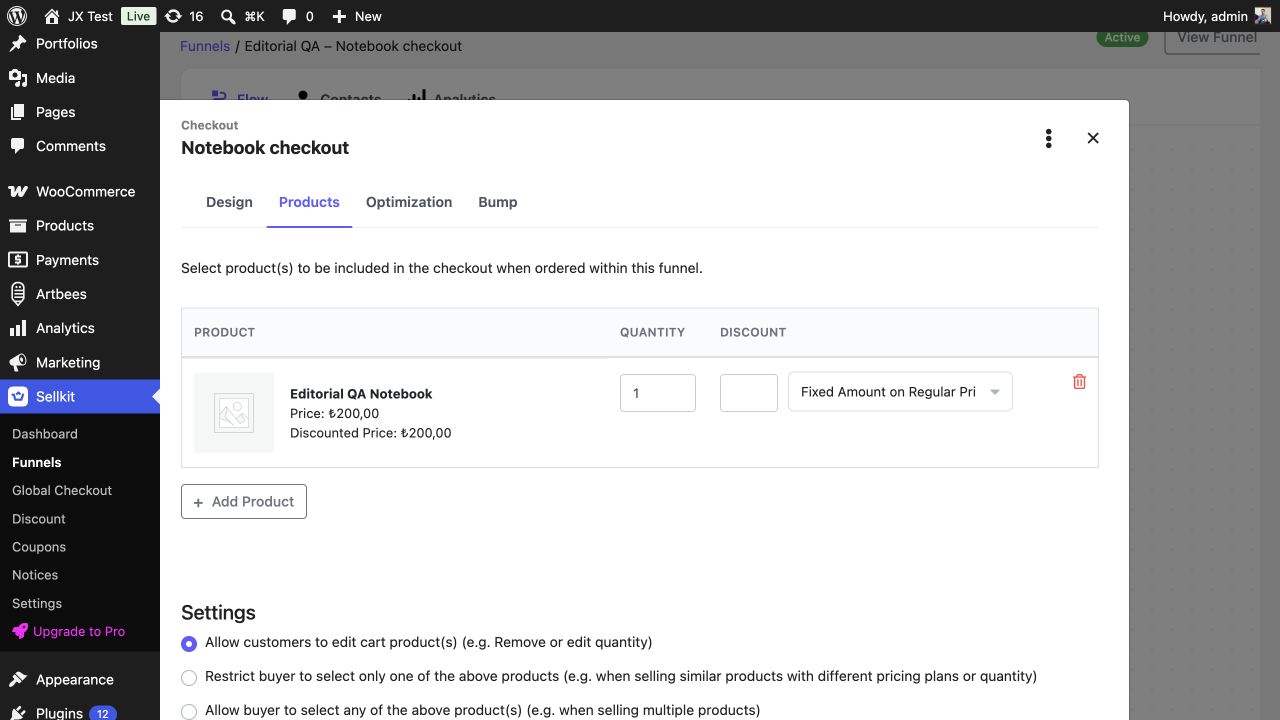
A funnel checkout is not automatically the same as replacing the store's global checkout. Verify how shoppers reach this step and where they go after it before connecting it to a live product or campaign.
3. Offer one relevant, optional order bump
An order bump is an additional product offered within checkout. Choose something that makes sense alongside the original purchase, and explain its purpose plainly. Avoid adding an unrelated offer just because there is space.
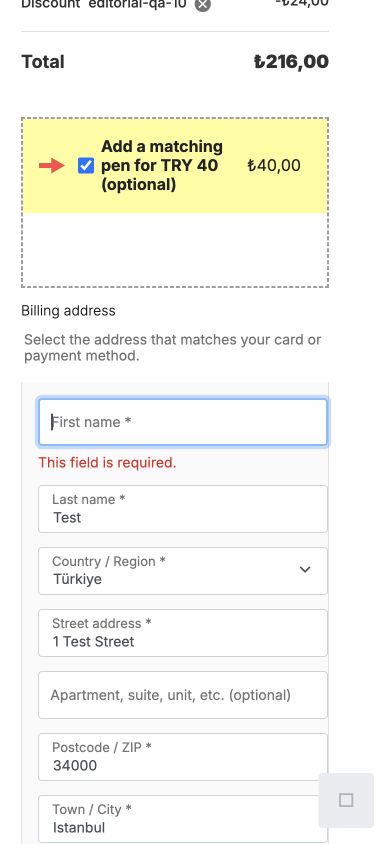
For example, our demonstration checkout pairs a TRY 200 notebook with an optional TRY 40 pen. Selecting the pen takes the total to TRY 240; removing it returns the total to TRY 200. With both selected, a 10% test coupon reduces the total to TRY 216. This example has no shipping charge or tax; check your own store's rules before comparing totals.
SellKit's documented setup starts in the checkout step's Bump tab. Add a bump, choose its product, configure its presentation and, where appropriate, conditions for showing it. The order-bump guide explains those controls.
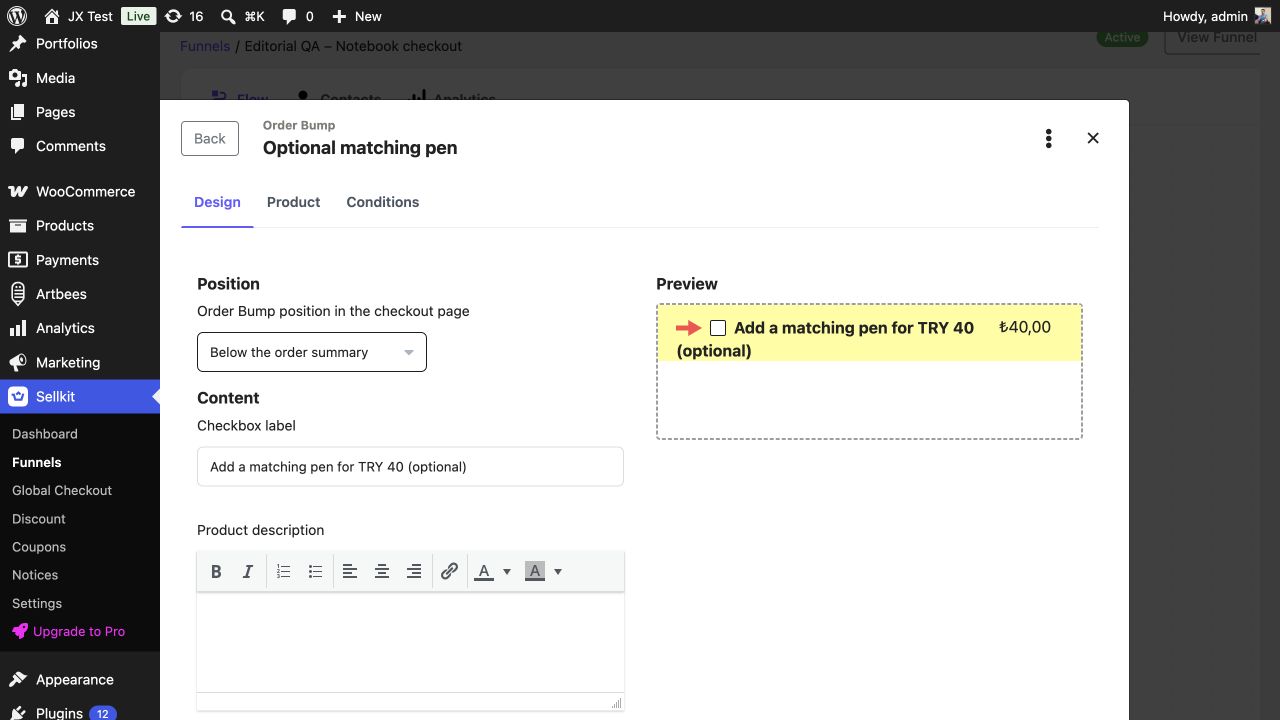
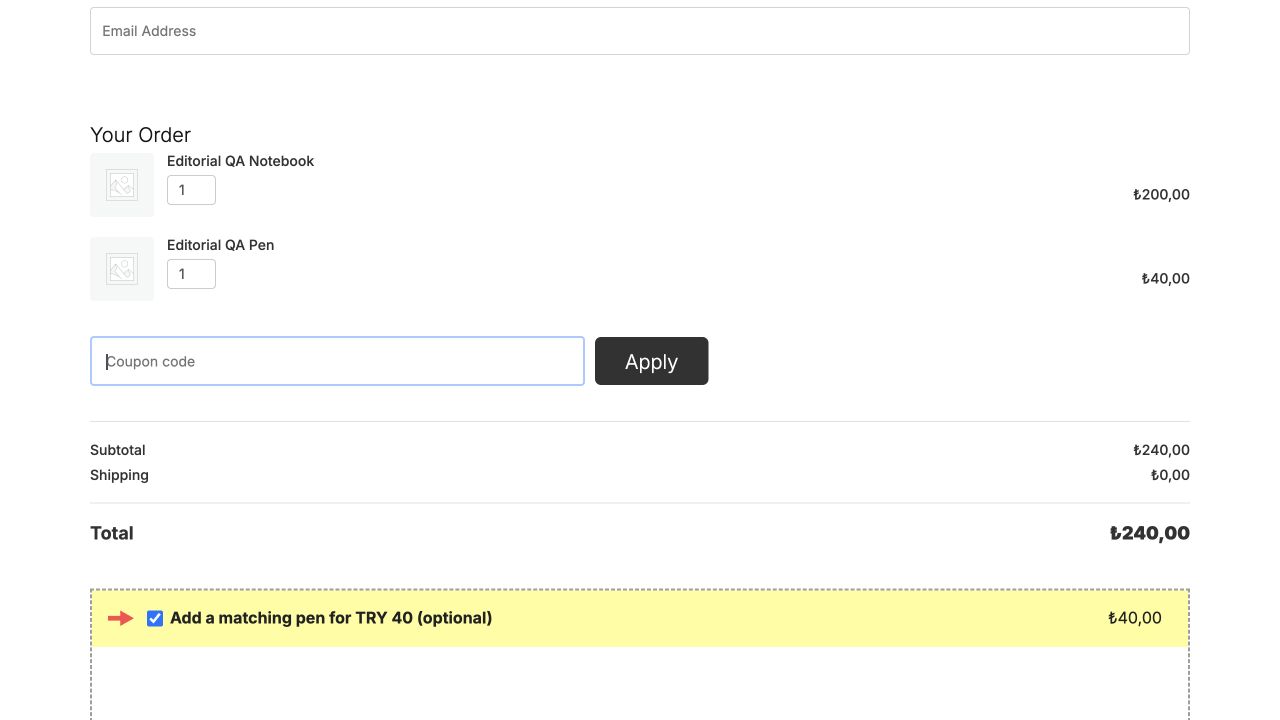
Treat the finished checkout as a two-way interaction: accepting the offer should add the intended item and update the price; removing it should reverse that change. Check what happens to shipping, discounts and tax in both states. A product's displayed price alone does not prove the final order calculation is right.
4. Keep shipping and offer messages accurate
A checkout message should describe a rule the store actually honors. If you display a free-shipping threshold, test it against the relevant destination, shipping method and coupon rules. A subtotal message can be misleading when the underlying shipping calculation uses different eligibility conditions.
Avoid countdowns that restart on every visit or promise dispatch the fulfillment team cannot meet. For made-to-order products, explain preparation separately from transit. Our WooCommerce product lead-time guide covers that distinction.
Check feature availability against your installed SellKit edition before designing around an advanced notice or condition. Do not assume an old Jupiter X bundle entitlement describes your current license.
5. Separate order bumps from post-checkout offers
An order bump and a later upsell are not interchangeable. SellKit's upsell and downsell guide describes offers following the checkout step, with paths for acceptance or rejection.
Before adding that extra step, verify the payment integration's requirements and test both choices. The shopper should understand whether accepting creates an additional charge and what happens if they decline. Keep the flow simple until the original checkout works reliably; a post-checkout offer is optional, not a prerequisite for improving the purchase experience.
For people who are not ready to buy, a wishlist addresses a different need. Our WooCommerce wishlist setup guide explains saving products for later, rather than adding another decision during payment.
6. Test the whole journey and measure cautiously
Check the actual journey on a phone as well as a desktop. Include guest checkout if your store offers it, a valid coupon, an invalid coupon, a missing required field and the add-on selected and removed. Use the keyboard to move through the form and make sure an error is readable without losing the information already entered.
For an authorized sandbox order, inspect the confirmation and the resulting order record. Verify the products, quantities, shipping, tax, discount and payment state. Reaching a thank-you page alone does not establish that payment succeeded.
After release, compare consistent reporting periods and separate paid orders from failed, cancelled or refunded orders. Watch checkout completion, order value and customer-support problems together. A higher average order value is not automatically a better result if fewer shoppers can finish buying.
Keep a record of the change date and other campaigns running at the same time. Analytics gaps, consent choices and changes in traffic sources can affect comparisons; do not attribute every movement to the new checkout.
Start with a clear checkout, then add the smallest useful improvement. Explore SellKit for its current checkout and funnel capabilities, and verify the features your store needs before deploying them.









Very good article. It has perfect content. Thank you.